


+45 87 730 330
Monday - Friday: 8:00 - 17:00
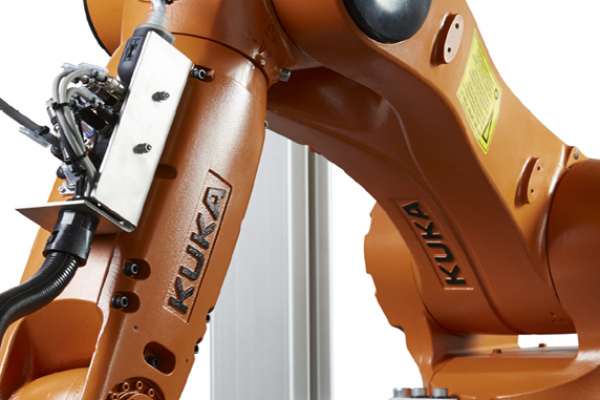
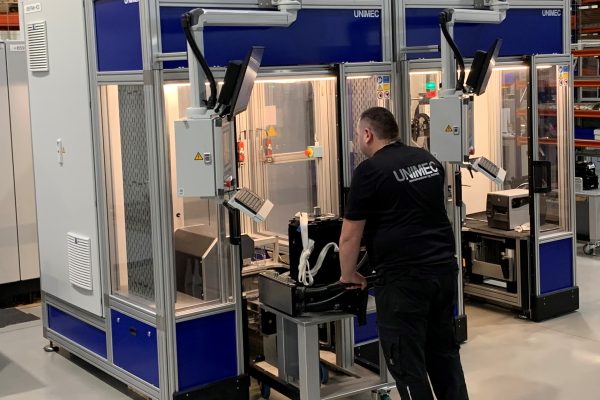
We were tasked with developing a piece of test equipment, which we solved as follows: A test part is manually placed on a pallet conveyor, which transports it into the robot cell. Inside the cell, the robot picks up the part and places it in a manipulator equipped with a vision system and a barcode reader. In the manipulator, the part is identified and aligned so the robot can handle it correctly. The robot then places the part in the tester, where a test function is performed, for example a high voltage test. Once the test is completed and approved, the robot places the part onto another pallet conveyor, which moves it out of the cell for manual handling. If the part does not pass the test, the robot places it on a separate conveyor, which transports it out of the cell for manual inspection. The robot cell is safeguarded by a protective enclosure made from aluminium profiles.
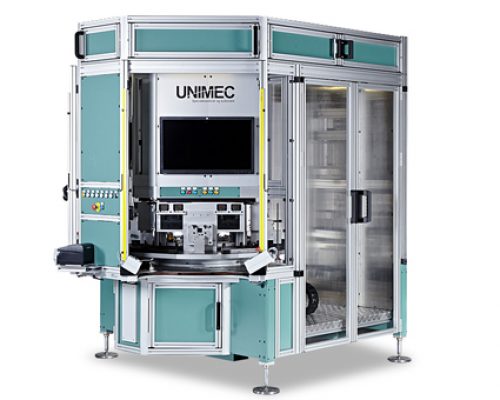
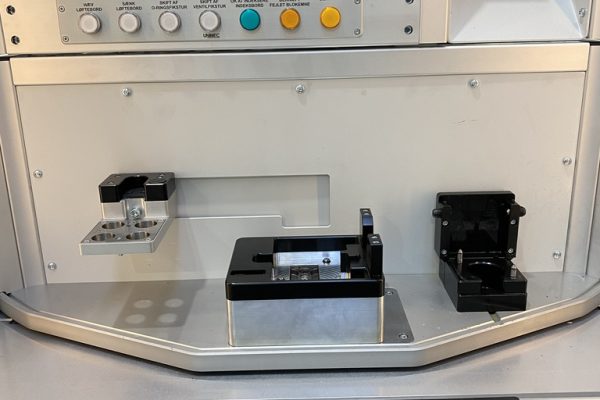
The development of this rotary indexing machine was a particularly interesting task, as it combines multiple elements and processes that must be coordinated into one unit. The machine is divided into four workstations. In station 1, the operator manually places a part. When the operator exits the light curtain area and presses “Start” on the front panel, the table indexes to the next station. In station 2, a conveyor supplies an additional part to be assembled by a servo-driven pick-and-place unit. The table then indexes to station 3, where the final part is supplied via a circular feeder and assembled using another servo driven pick and place unit. Finally, the table indexes to station 4 for manual removal and visual inspection of the assembled part.
This machine produces springs, and these springs must be checked and measured. The spring is picked up onto a timing conveyor, which transports it into the measuring machine. Here, it is placed in a fixture on a servo-indexing conveyor. Along this conveyor, several measuring and inspection stations are positioned, where the spring is tested to ensure high production quality.
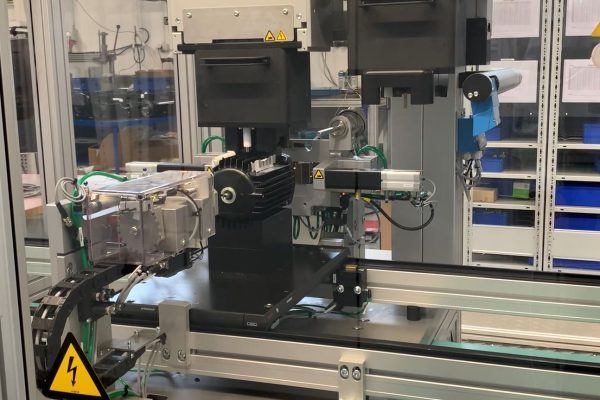
The motor tester performs an electronic test of a motor. The motor is placed on a pallet on a pallet conveyor, which transports it into the machine through automatic safety doors. Inside the machine, the pallet is lifted off the conveyor, and a top fixture is connected to the motor, allowing the test procedures to be carried out. Once the motor has passed the test, it is transported out through a safety door, and a new motor is brought into position, ready for the next test cycle.
In this assembly machine, all components for the assembly process are manually loaded. The components are placed on a rotary indexing table and consist of two parts that must be screwed together, along with five O-rings.
Once the table indexes, an O-ring is automatically mounted onto one of the parts using a dedicated assembly tool, and a vision system checks that it has been placed correctly. A robot then positions the mating part, and a screwdriving system fastens the two elements together. After assembly, the part is transferred to a leak tester where it is tested for leaks. The fully assembled and tested part is then placed back in the rotary table and returned to the operator.
The motor tester performs an electronic test of a motor. Since the motors can weigh up to 130 kg each, they are placed on a trolley. The trolley is manually pushed into the machine through a safety sliding door. Inside the tester, the trolley is lifted off the floor to ensure the correct positioning of the motor for fixation. Before the motor is moved into the tester, an operator manually mounts a test adaptor to ensure the required electrical connection. A top fixture is then connected to the motor, allowing the test procedures to be carried out. In addition to electronic testing, a rotation test and a torque test are also performed. When the test is completed, the operator removes the trolley.
Developing robotic solutions is often a complex process involving multiple components. We guide you from start to finish.
We design automated assembly machines for customers in both domestic and international markets. We use a range of methods when developing solutions for product processing.
We manufacture machines that use technologies such as spot welding, ultrasonic processing or waterjet cutting to perform tasks according to customer specifications.

As designers and manufacturers of special machinery, we have many years of experience and have developed core systems that are used across our machines.
We offer a wide range of aluminium profiles and fittings. The full selection is available through the link below.

Passion driven engineering
Tel.: +45 41 82 58 15
Email: msh@1.nutestervibareligeokay.dk

Tel: +45 21 13 91 90
Email: ltm@1.nutestervibareligeokay.dk

Tel: +45 21 13 87 85
Email: hla@1.nutestervibareligeokay.dk