

+45 87 730 330
Monday - Friday: 8:00 - 17:00
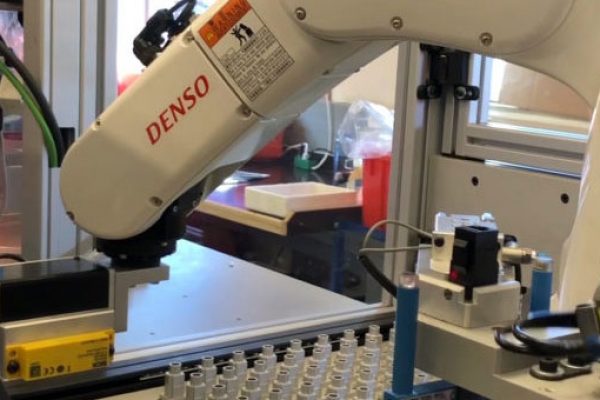
Our customer needed a solution for gluing and assembling components. Three different types of parts are fed into the robot cell on three identical conveyors, where they are individually handled by a pick and place robot. The robot tool picks up each part and places it at the assembly position in a programmed sequence. Here, a second SCARA robot applies two component adhesive and, in perfect coordination with the first robot, assembles the three glued parts into a single unit. The finished unit is placed on a conveyor that transports it out of the robot cell, and the process then starts over. The robot cell is surrounded by a safety enclosure constructed from aluminium profiles.
This robot cell is designed for assembling electronic connectors. The machine consists of several elements. A servo press with a cutting and punching tool separates a component, which is then placed on a rotary indexing table. On this table, the part is bent and formed, and additional components are assembled, supplied by a circular feeder. A vision system monitors the process. The part is then transferred to another rotary table, where more components from a circular feeder are added and checked by another vision system. The main housing is assembled by a 6-axis robot. Once assembly is complete, the part is placed on a servo-indexing conveyor, which moves it through several electronic tests, including a high voltage test. The fully tested part is laser engraved with a unique number.
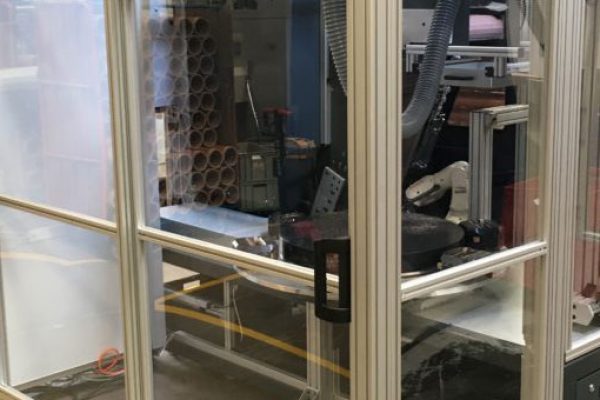
This production machine is designed to cut guide rings used in hydraulic cylinders. The guide rings are mechanically separated and fed onto a conveyor with dividers, ensuring that each ring is positioned individually for the robot to pick up. The robot places the guide ring into a vise mounted on a rotary indexing table. The table then indexes the part to a high speed saw, which can be adjusted to cut at different angles.
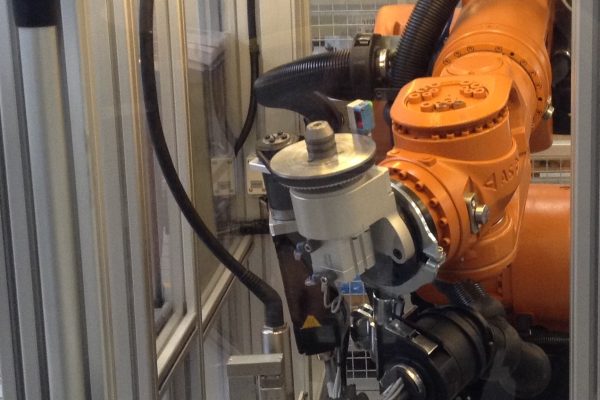
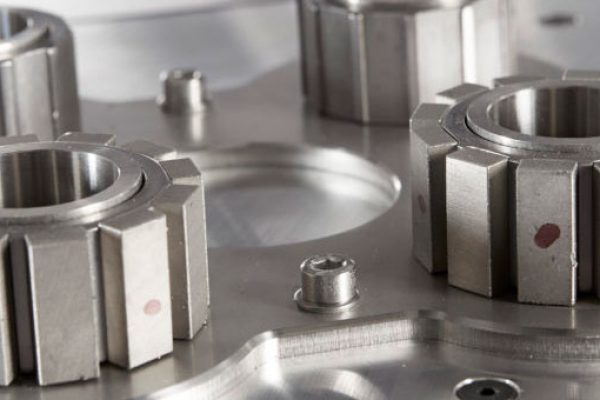
This robot cell is designed to assemble magnets into a magnetic coupling. The parts are placed on a pallet, which is then transported into the robot cell by a pallet conveyor. Inside the cell, a robot installs the magnets, which are individually dispensed from a magazine. During this process, the magnet is separated from the plastic spacer. The entire robot cell is built on a robust height-adjustable frame.
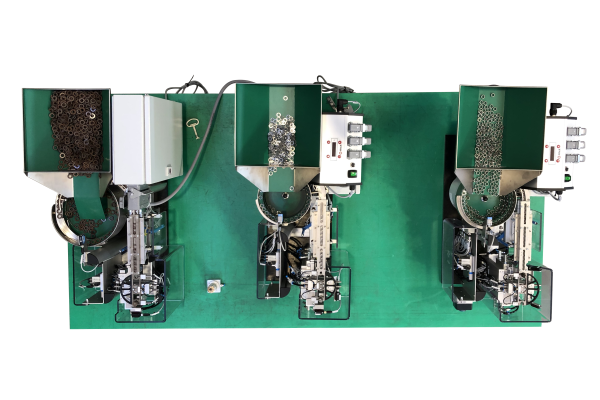
These part feeders supply components to a robot, which installs them in an injection molding machine. They are built as stand alone units, which allows them to be moved between 15 different machines.
Developing robotic solutions is often a complex process involving multiple components. We guide you from start to finish.
We design automated assembly machines for customers in both domestic and international markets. We use a range of methods when developing solutions for product processing.
We manufacture machines that use technologies such as spot welding, ultrasonic processing or waterjet cutting to perform tasks according to customer specifications.

As designers and manufacturers of special machinery, we have many years of experience and have developed core systems that are used across our machines.
We offer a wide range of aluminium profiles and fittings. The full selection is available through the link below.

Passion driven engineering
Tel: +45 41 82 58 15
Email: msh@1.nutestervibareligeokay.dk

Tel: +45 21 13 91 90
Email: ltm@1.nutestervibareligeokay.dk

Tel: +45 21 13 87 85
Email: hla@1.nutestervibareligeokay.dk